
Journal Information
| Original title | : | Journal of Digital Sharia and Contemporary Legal Thought |
| Abbreviation | : | JDSCLT |
| Frequency | : | 2 issues per year (June and December) |
| Number of articles | : | 5 research articles and reviews per issue |
| DOI | : | https://doi.org/10.64685/JDSCLT |
| ISSN | : | 3124-6648 |
| Editor-in-Chief | : | Dr. Fahruddin Ali Sabri, S.H.I., MA |
| Publisher | : | Zamzami Scholar Publishing |
| Citation Analysis | : | Google Scholar; Garba Rujukan Digital |
| Subject Area | : | Arts and Humanities |
| Category | : | Religious Studies |
| Discipline | : | Digital Sharia Studies; Digital Religion and Law; Digital Socio-Legal Studies; and Digital Islamic Legal Studies |
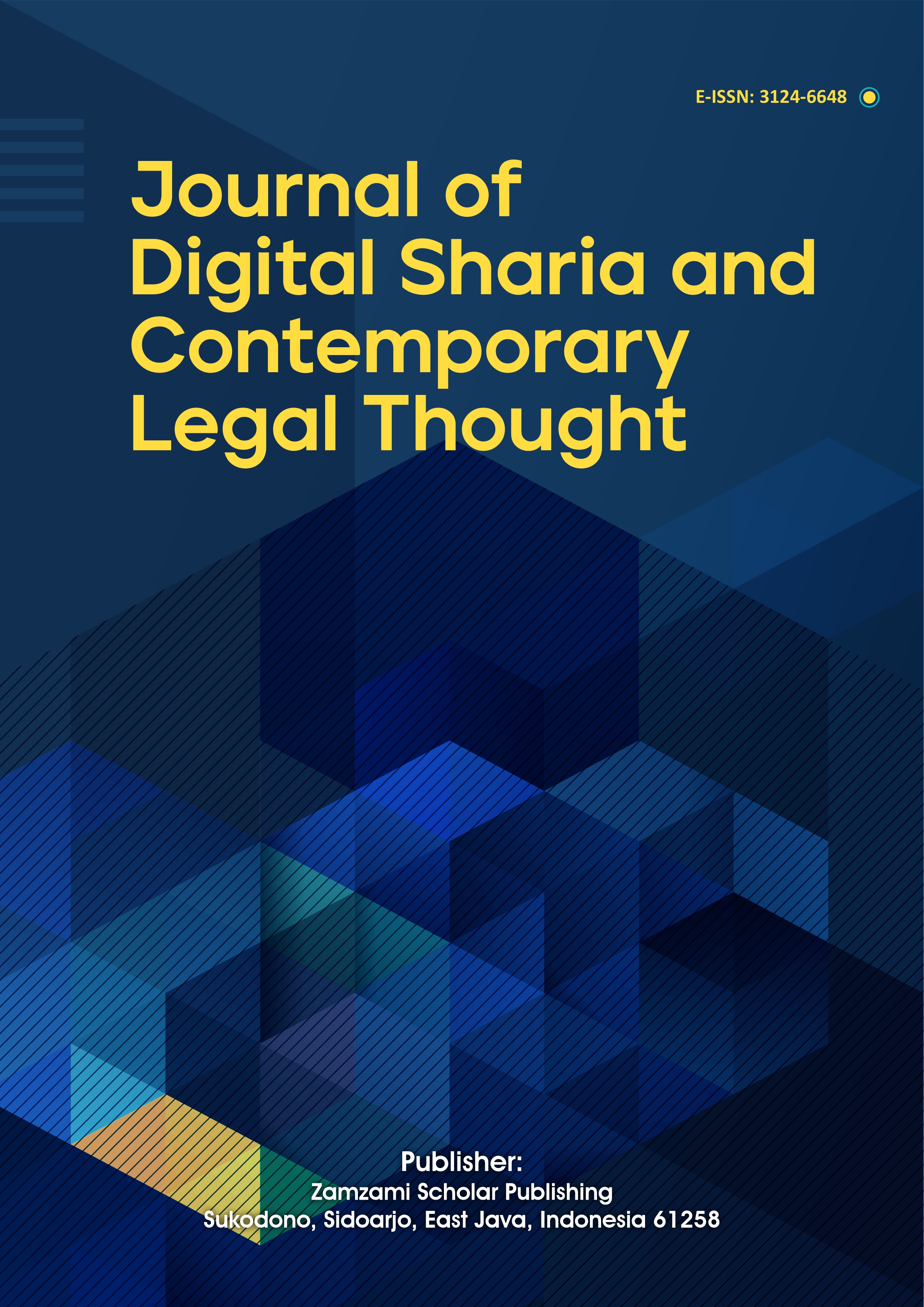
The Journal of Digital Sharia and Contemporary Legal Thought (JDSCLT) is an international, peer-reviewed scholarly journal published by Zamzami Scholar Publishing (Sidoarjo, East Java, Indonesia). The journal is dedicated to advancing empirically grounded and theoretically informed scholarship on the transformation of Islamic law in contemporary digital environments. It examines how digital media, platform infrastructures, and emerging technologies reshape the production, circulation, interpretation, and contestation of Sharia and Islamic legal thought, with particular attention to the reconfiguration of legal authority, normativity, and religious knowledge in data-driven societies.
Positioned at the intersection of Islamic legal studies, socio-legal research, and digital culture, JDSCLT prioritizes interdisciplinary contributions that engage critically with current debates on law, religion, and technology. With a regional emphasis on Muslim societies in Southeast Asia and openness to comparative and global perspectives, the journal focuses on key areas such as digital mediation of Islamic legal discourse, transformation of religious authority in online environments, artificial intelligence and algorithmic legal reasoning, digital contestation of family law and gender issues, and platform governance, data ethics, and regulation in Islamic legal contexts.
JDSCLT publishes original research articles that demonstrate conceptual clarity, methodological rigor, and strong empirical grounding. The journal emphasizes social-scientific and socio-legal approaches, while submissions based solely on normative theological argumentation without analytical engagement are generally not considered. By fostering systematic and critical inquiry, JDSCLT contributes to international scholarly discussions on religion, law, and digital transformation.
Current Issue
Vol. 1 No. 1 (2026): June
Published: 2026-06-02