
Journal Information
| Original title | : | Journal of Indonesian Digital Islamic Studies |
| Abbreviation | : | JIDIS |
| Frequency | : | 2 issues per year (June and December) |
| Number of articles | : | 5 research articles and reviews per issue |
| DOI | : | https://doi.org/10.64685/JIDIS |
| ISSN | : | 3124-7776 |
| Editor-in-Chief | : | Prof. Dr. Abd A'la, M.Ag |
| Publisher | : | Zamzami Scholar Publishing |
| Citation Analysis | : | Google Scholar; Garba Rujukan Digital |
| Subject Area | : | Social Sciences; Arts and Humanities |
| Category | : | Religious Studies; Media and Communication; Digital Culture and Society |
| Discipline | : | Digital Islamic Studies; Digital Culture Studies |
The Journal of Indonesian Digital Islamic Studies (JIDIS) is an international, peer-reviewed, open-access academic journal published by Zamzami Scholar Publishing (Sidoarjo, East Java, Indonesia) that advances theoretically informed and empirically grounded scholarship on the intersections of Islam, media, and digital culture. The journal conceptualizes digital Islam as a transformative socio-cultural and epistemic domain in which religious knowledge, authority, identity, and practice are continuously produced, mediated, and contested through digital infrastructures. It prioritizes analytically rigorous, theory-driven, and methodologically sound research grounded in the social sciences, rather than normative theological argumentation.
Positioning Indonesia as a strategic site of inquiry, JIDIS highlights how the world’s largest Muslim-majority democracy offers critical insights into broader global transformations of religion in digitally mediated societies. The journal encourages comparative, regional, and transnational perspectives that connect Indonesian cases with wider theoretical and empirical developments in digital religion and media studies, in line with international scholarly expectations such as Scopus and Web of Science.
JIDIS publishes original research that contributes to interdisciplinary and social-scientific analyses of Islam in digital contexts, with a focus on key issues such as the mediation of Islamic knowledge and authority, platformized da‘wah and religious pedagogy, digital identity and everyday religious practice, religion and politics in the digital public sphere, and the role of algorithms and platform governance in shaping contemporary Islamic culture.
Current Issue
Vol. 1 No. 1 (2026): June
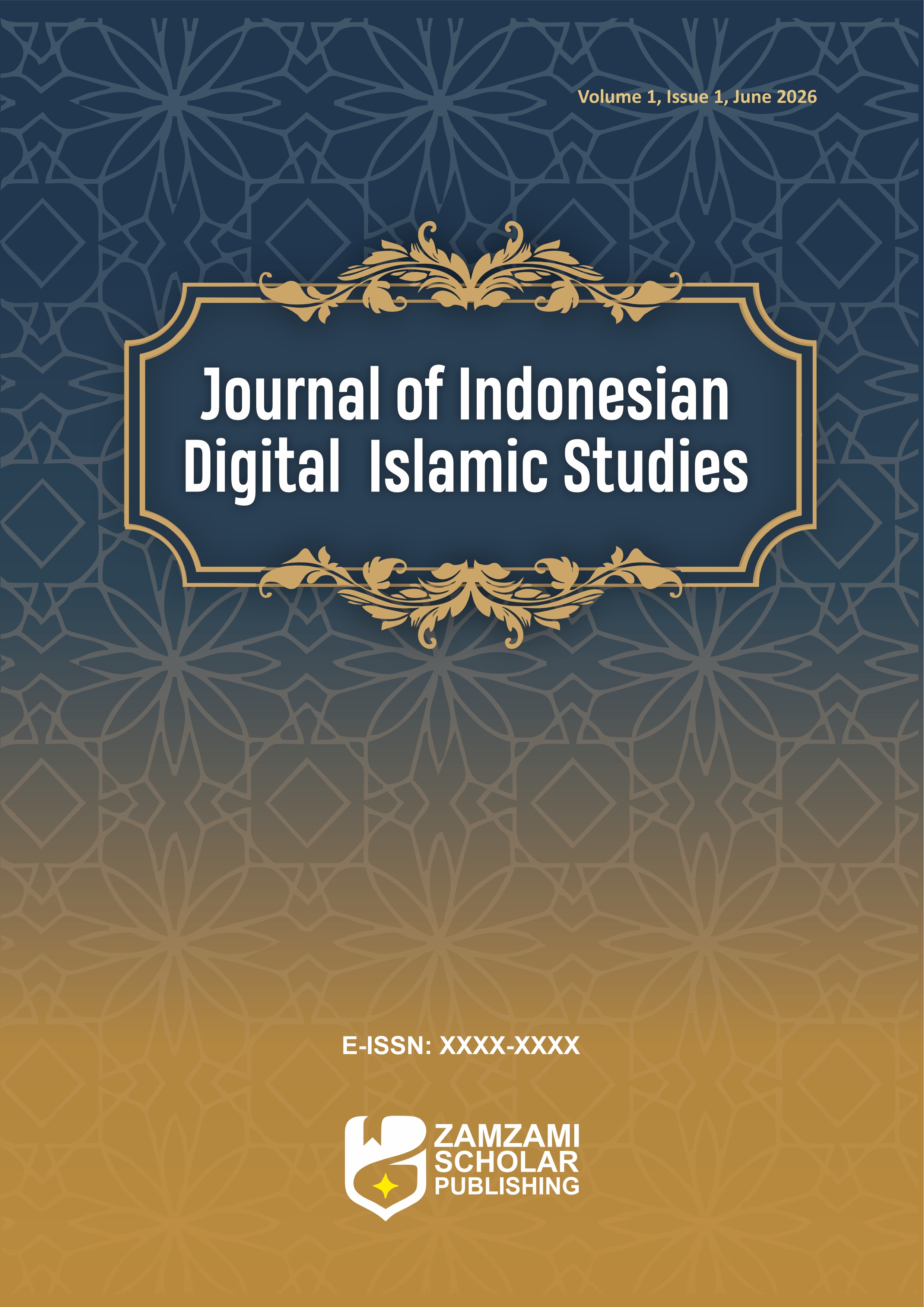
Published: 2026-06-10